

Substack Growth Gurus Have a Secret And It’s Not What They’re Teaching You
Here’s the quiet bias they use to fool us all.

You’ve probably saved at least a dozen posts about Substack growth.
Content pillars
Note templates
Engagement strategies
Optimal posting frequency
You read them, felt that little spark of yes, this is the missing piece, and then... nothing changes.
Maybe you wonder if you’re the problem: maybe you’re not consistent enough, or your positioning isn’t tight enough, or you haven’t found your voice yet.
But that is not what is really happening. The people teaching you how to grow on Substack have no idea why they grew in the first place.
When you finish this article you’ll know what is the cognitive trap the gurus use against you, so you think that they know how to grow on this platform. And let me tell you it has nothing to do with how many notes you post or your hooks—well, maybe your hooks.
What Is Survivorship Bias and Why Does It Explain So Much?
Survivorship bias is what happens when you take advice from winners, even when luck caused their win.
Imagine a coin flipping tournament. Everyone who flips tails is eliminated. You do this over and over until one person wins—in this case by flipping heads more than anyone else.
Now watch what happens: the rest of the participants floods toward that person asking how they did it. Someone pulls out a notebook. Another person asks them to please do a webinar. Within six months they’ve got a course called The Heads Method and a waitlist of eager students paying to learn their “process.”
Humans brains give more weight to the words of someone who has been successful, even if that success was actually the result of random chance. Flipping a coins.
We call this Survivorship bias: the tendency to look only at the “survivors” or exceptions in any given situation. We ignore what didn’t survive and this can lead to false conclusion.
The winners genuinely believe they have something figured out. we look backward at their success and reverse-engineered a story to make sense of what happened. Consistency. Mindset. Showing up every day...
What we don’t see is the hundred people who did all the same things and got eliminated anyway!
What Did the Substack Growth Accounts Actually Do Differently?
Do you want to know their secret? They started 1 to 3 years before you. That’s their competitive advantage, in full.
The platform was less crowded when they arrived. The recommendation engine was actually working. The algorithm rewarded early movers. Their subscriber list grew during a period when growing was genuinely easier. This has nothing to do with their content strategy or anything they trying to sell you.
And now? the algorithm favors accounts with larger subscribers and it shows the content to more people, while we mistake them with authorities because they have 5 figures in their subscriber count.
When I look at the writers who now position themselves as Substack growth experts, the variable that correlates most with their success isn’t their posting times or their hook structure. It’s only their start date.
But I don’t blame them because they can’t see it either. Their brains found a narrative that explained the outcome. So they teach that narrative with total sincerity. They’re as fooled by survivorship bias as their audience is.
How The Self-Fulfilling Growth Wheel Works?
The growth account builds an audience. Eventually they launch a course or a paid community. A hundred people sign up. Ninety-nine spin their wheels and see modest results. But one of the through some combination of effort, timing, and luck actually grows.
That one person becomes the case study.
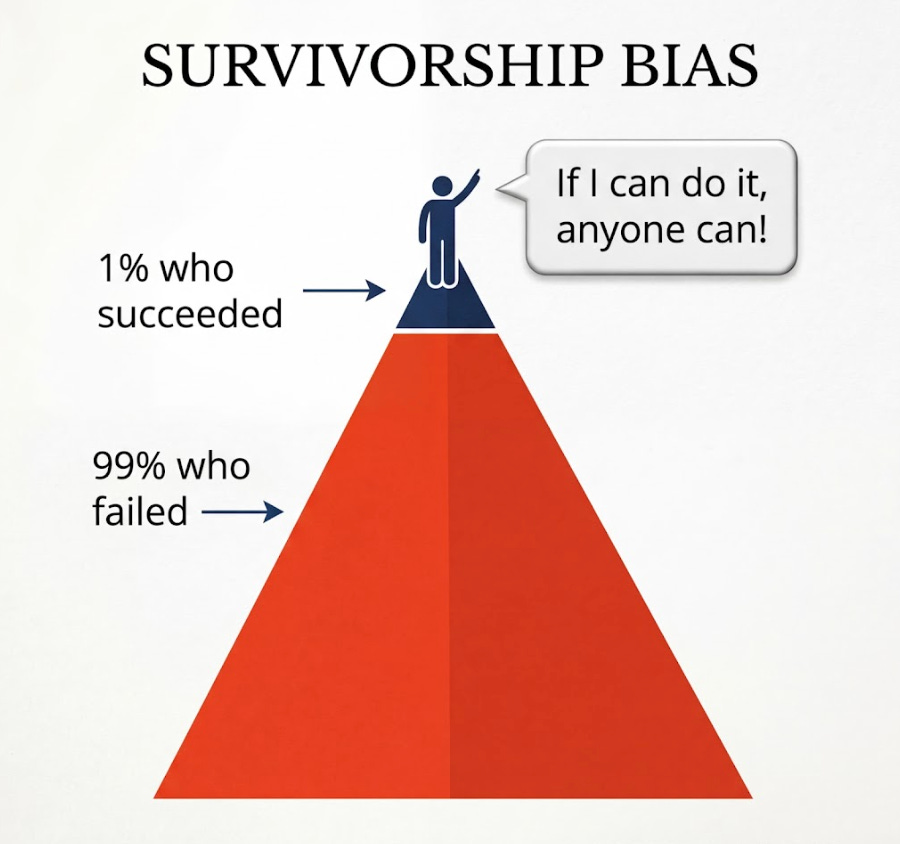
Suddenly there’s a testimonial. A screenshot. A success story that gets turned into a post, then a sales page, then a pitch for the next cohort. The survivorship bias wheel spins again, this time with fresh students who saw the proof and thought: that could be me.
I’ve seen this exact playbook in trading. The forex guru with a course full of testimonials from the one student out of hundreds who actually made money. The rest are invisible. They don’t post about their losses. The system doesn’t need everyone to win. It just needs enough winners to keep the story credible and the next wave of students buying.
One survivor out of a hundred is enough to power the whole machine.
What Should You Actually Do Instead?
Keep writing, stay consistent, and build your own understanding of what works for you.
The real variables in newsletter growth are boring and unglamorous: clarity of audience, quality of writing, and showing up long enough for the compounding effect to kick in. None of those require a guru. All of them require you to develop genuine judgment about your own writing. Not borrowed tactics from someone who got lucky with timing.
Instead of learning to crack the platform’s algorithm learn to write words that move people. That skill is yours to keep, regardless of which platform you’re writing.
Focus on your writing. The rest is noise.
Great article! I got here after that wave, so I’ll just keep plugging away and staying consistent
tldr: successful accounts started earlier
kinda true, but not the whole story
there are newer accounts who grew fast successfully. some of it may be luck, some might be off-platform advantages. but if you really want to grow you actually need one more thing - talking to people
get outside of 1-to-many writing echochamber and start sending DMs to people