

Is Social Media Still Necessary? The Unbelievable Post That Convinced Me to Delete My Accounts for Good
How to find an extra 2,000 hours a year by deleting just a dew apps.

Welcome to depth creation. Each week, I send thoughtful ideas and systems to help you transform scattered interests into consistent writing, build your unique worldview, and turn deep thinking into meaningful income. If you’re ready to consume less, create more, and escape the shallow content cycle, join our community of deep thinkers. You’ll get weekly frameworks for intentional research, thought mapping techniques, and a clear path from ideas to income.
The average screen time of young and middle age adults is around 6.5 hours.
That’s nearly a full workday, every day. More than a quarter of our waking lives, gone to scrolling, and reading things someone else chose for us. Now imagine all the things you could be doing with those hours: learning a new skill, getting fit, starting a project, or simply resting or enjoying the outside. Suddenly, all those things you tell yourself you “don’t have time” for don’t seem so far-fetched.
A few months ago, I was having sleep problems. I would wake up in the middle of the night and struggle to fall back asleep. Instead of resting, I would be scrolling through X for entertainment. That’s when I realized something was wrong. Did I really want to do this? Or was it just a reflex, a habit I had developed to fill empty moments?
In this letter, I’ll explore whether social media is truly necessary in our lives. I’ll share how I quit all the apps, regained focus and meaning in my life, and how you can apply the same principles to do the same.
My first contact with social media was around 2010, when some classmates insisted I download Twitter. I was never drawn to those platforms, but social media is, by definition, social, and my friends were pushing me to join. The only thing that attracted me to Twitter specifically was that most of my friends and family didn’t have it, but many public figures and famous people were using it like a press release service, which made it feel oddly official.
My second contact with social media was Facebook in 2012. At that time, Facebook was in it expansion phase, and the platform didn‘t have much spam, or ads. To attract as many users as possible. I was starting college and saw that everyone on campus was using it as a contact list. Many events were only published on Facebook, so it became a good way to stay social and know what was going on.
At that point, I still wasn’t hooked. I only used social apps to talk to new friends, check what events were happening that week, or follow the latest news.
Then Instagram came along, and just like before, I joined because “everyone was using it.” At the beginning I tried posting a few travel photos, but I never understood the appeal of sharing my private life online. Still, when I moved away from my home country, Instagram became my main link to friends and family. That’s when started to feel uncomfortable. My feed was filled with everyone’s life highlights, perfect meals and sunny vacations —While I sat in Germany under a grey sky eating mediocre food. I knew some of those posts were staged or exaggerated, but it didn’t stop the creeping feeling of FOMO .
This was when I started to develop an aversion to Instagram. As for Facebook, I had already stopped using it; it no longer fulfilled its purpose of helping me manage contacts and events.
For a while, Twitter was the only social media app I used. Around 2018, I found real value there, new information, guides, conversations that felt genuine. But slowly the app began to change and my feed started to shift from “Finance Twitter“ into “Money Twitter”. The algorithm started to changed to keep users on the platform as long as possible, rewarding controversy, recycled tips, and empty case studies —all clickbait. Dominated by shallow advice from inexperienced teenagers, packaged in flashy threads that promised the world and delivered nothing.
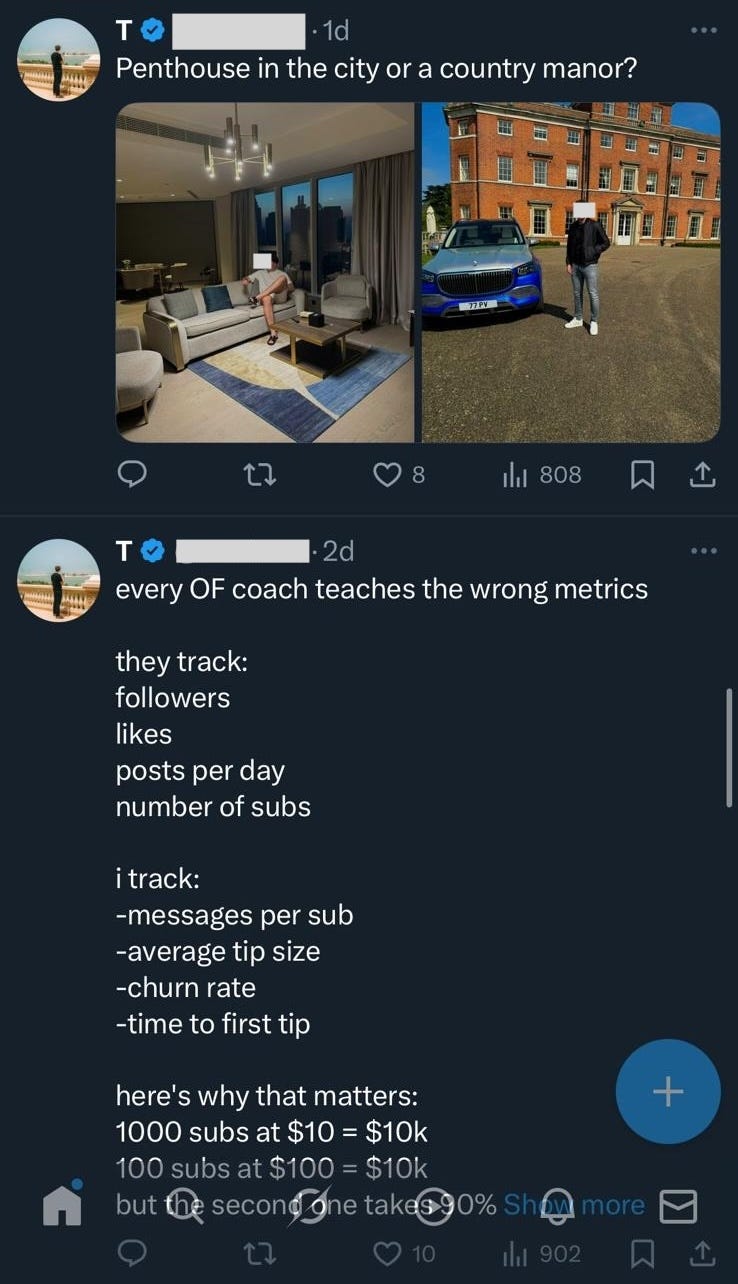
The moment I knew I was done came quite recently in 2025, when I saw a post proudly promoting an OnlyFans agency as a legitimate business model. It explained how to recruit girls to pose on camera and chat with lonely men, all while cutting corners and maximizing returns. That was it. Now online pimping is legal and marketed as entrepreneurship, there was nothing left of the moral boundaries that once existed. Anything could be turned into content if it generated engagement.
That‘s when I realized I was addicted, I had unconscious tics to open social media apps only to mindless scroll without getting anything in return. I noticed it especially in the mornings: the first thing that I would do was opening this apps and fry my brain before the day even began.
“What characterizes an addiction? Quite simply this: you no longer feel that you have the choice to stop. It seems stronger than you. It also gives you a false sense of pleasure, pleasure that invariably turns into pain.” — Tolle, Eckhart
When you’re addicted, stepping away is not easy. It comes with dread and withdrawal. Thanks to some blocking apps, I prevented myself from opening X until after 6 p.m., and slowly I stopped craving the dopamine hits of scrolling. I realized it had all been a big waste of time—at least at this stage of my life.
What I want to say is that social media doesn’t have to be bad. But it does have to give you something valuable in exchange for your time and personal information.
If you’re opening an app out of reflex and not getting anything out from it, pause and observe your behavior. Maybe you don’t need to open it at all. Maybe you’re just doing it out of inertia.
By becoming more conscious of your actions, you can redirect your focus, and your precious hours toward something that will benefit you in the long run. When I finally stepped away, I didn’t just remove the apps. I replaced them with deep lectures and dense books by people who had dedicated years to their subjects. These authors don’t write for likes or shares; they write to share their knowledge and life’s work on their specific fields. It’s the opposite of the algorithm and that’s exactly why it’s worth my time.
This is just my perspective, and I believe the best ideas emerge from different angles. What's your experience with this? Would you add or refine anything?
If you found value in this, sharing it helps build our community of deep thinkers. Much appreciated.
Depth creation is for thoughtful people who want to consume less, create more, and build something real through thought leadership.
If you’re tired of shallow content and want to develop your own philosophy, attract ideal readers, and create sustainable income from your ideas. Join us!