

Can You Make Your Own Luck?
Can you actually make your own luck? This psychologist says yes.

Why other people seem to stumble into opportunities while you’re still stuck waiting for your break?
Dr. Richard Wiseman, a psychologist at the University of Hertfordshire, spent a decade investigating whether luck is just cosmic chance or something you can actually cultivate.
In this article we’ll see if what he discovered can change how you think about those “lucky breaks” you’ve been waiting for.
Why Study Luck in the First Place?
Wiseman wanted to answer a question that haunted him: why do some people consistently experience favorable outcomes while others face endless setbacks?
He wasn’t interested in mystical explanations or vague motivational nonsense. He wanted to know if there were measurable behaviors that separated the lucky from the unlucky.
The stakes were clear: if luck was just random chance, there’s nothing you could do about it. But if it was tied to specific habits and mindsets? That meant you could engineer your own good luck.
The Newspaper Experiment
Wiseman recruited hundreds of people who identified as either very lucky or very unlucky. Then he gave them a simple task: count the photographs in a newspaper.
Hidden on page two was a half-page message in huge letters:
”Stop counting. There are 43 photographs in this newspaper.”
The lucky people spotted it almost immediately. The unlucky ones? They missed it entirely, diligently counting every single photo.
Why? The unlucky participants were so focused on their assigned task that they completely overlooked an obvious shortcut. The lucky ones stayed relaxed and alert, scanning their environment for anything useful. Same newspaper. Completely different outcome based purely on how they approached the task.
Wiseman ran variations of this experiment across multiple scenarios—testing whether people noticed opportunities, engaged with strangers, or took alternate routes. The pattern held every time.
Results Revealed
People who called themselves lucky consistently noticed and acted on opportunities faster than those who identified as unlucky. This wasn’t about magic or fate but something else entirely.
The lucky participants approached situations with curiosity rather than rigid focus.
They talked to strangers.
They tried new things.
They expected good outcomes, which made them more likely to pursue possibilities when they appeared.
And when things went wrong? They reframed setbacks as temporary rather than permanent.
The unlucky participants did the opposite. They stuck to routines, avoided unfamiliar situations, and expected disappointment—which meant they rarely positioned themselves to catch a break even when one appeared.
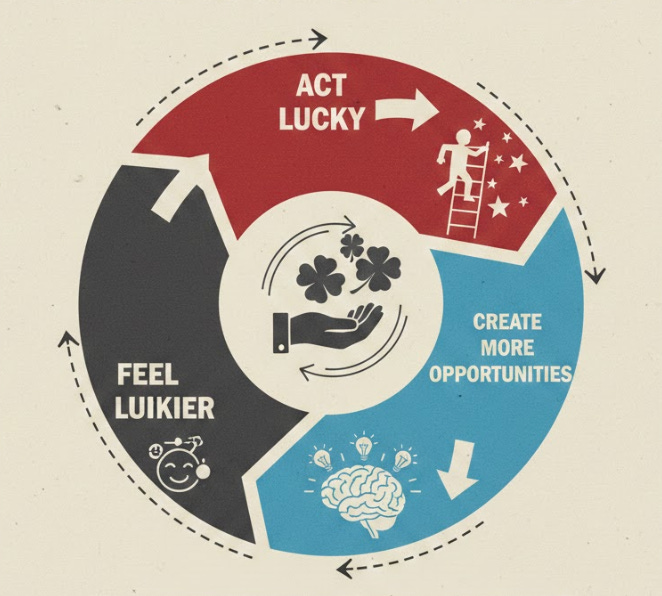
The good news? when Wiseman taught ”unlucky” people to adopt lucky behaviors, their outcomes improved measurably. The feedback loop worked both ways. Act lucky, and you create more opportunities. Create more opportunities, and you feel luckier. Feel luckier, and you keep acting in ways that generate favorable outcomes.
How to Actually Use This?
Want to test Wiseman’s findings yourself? Start with these:
Take a different route occasionally. Literally. Walk a new path to work, try an unfamiliar coffee shop, sit in a different spot. You can’t stumble into opportunities if you never vary your routine.
Keep a ”luck diary.” Write down one positive or unexpected thing that happened each day. This primes your brain to notice favorable events instead of filtering them out as background noise.
Talk to people you don’t know. Lucky people in Wiseman’s studies were significantly more social and open to chance encounters. That person in line could be your next collaborator—but only if you say hello.
Reframe setbacks fast. When something goes wrong, ask ”what’s useful about this?” instead of dwelling on the failure. Lucky people bounce back because they don’t let one bad outcome define their entire trajectory.
Subscribe to this free newsletter 👇
Your Turn
Wiseman’s research strips away the mystery around luck and reveals something more useful: a toolkit of habits anyone can adopt. You’re not waiting for the universe to favor you. You’re expanding your surface area for opportunity to find you by changing how you move through the world.
Try one of these habits for a week and see what shows up. You might be surprised by what you’ve been missing.